I’m reading Barry Loudermilk’s book, And Then They Prayed. I specifically want to write about a chapter that I read this morning that spoke to me.
The chapter about George Washington in Valley Forge gave an in-depth view of the challenges of Valley Forge. The interesting thing is that Valley Forge is so ingrained into our nation’s history in the struggle for independence and yet it was not a battle in the conventional sense of the word.
It was not a battle against the British army, it was a battle against the elements. It was a battle against low morale. Basically, it was the Colonial Army’s determined stand to survive and General Washington’s leadership – not into confrontation with the British, but in a confrontation with bitter cold, lack of food, and fatal disease.
Washington would comment that no history in existence could furnish such an example of men without clothes, blankets, and even shoes while not murmuring or complaining. The conditions at the camp deteriorated with each passing day.
Washington’s staff selected for his headquarters, the home of a pacifist Quaker by the name of Isaac Potts; however Washington insisted on staying in his leaky, cold tent until every last soldier had access to warm quarters.
Every morning Washington would mount his horse and make rounds through the camp, not to inspect for neatness, but out of pure compassion for the welfare of his men. He would later report to congress that he was convinced that unless some great change took place, the army would either starve, dissolve, or disperse.
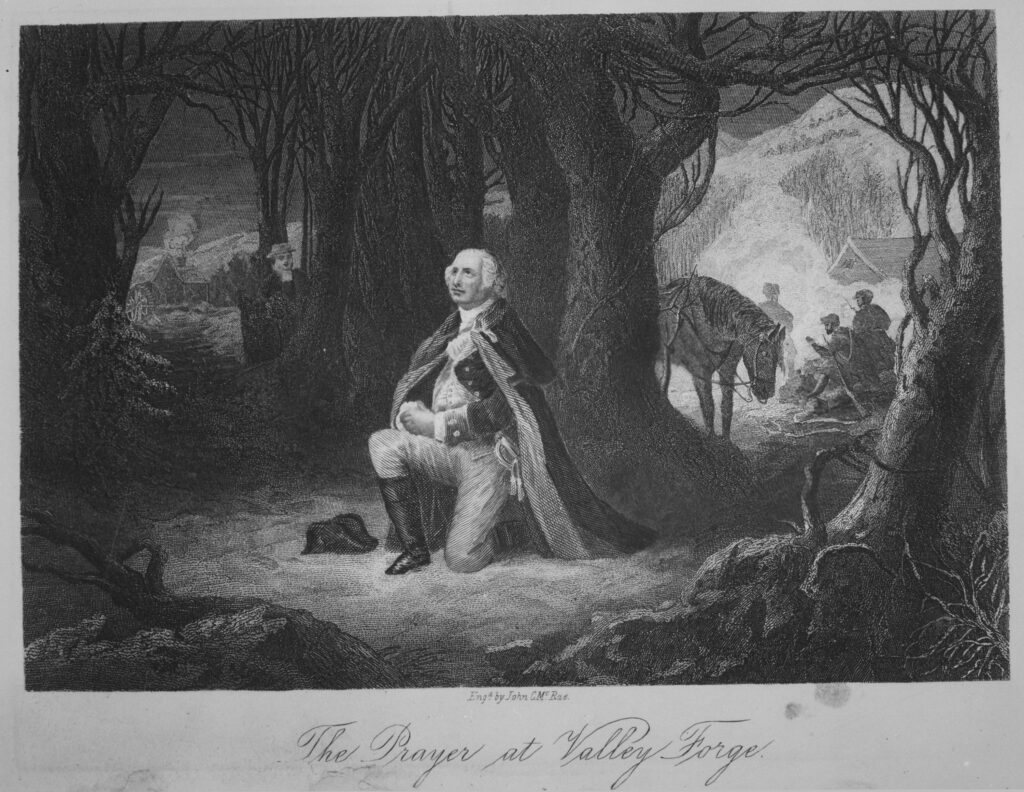
Each day, Washington would retreat to the forest and kneel to pray. The pacifist, Potts, who did not believe that a soldier could also be a Christian, overheard Washington’s prayer one day. He returned home and told his wife that he was greatly mistaken if Washington was not a man of God. He also said that he was now convinced that God heard the prayers of Washington and would do something great for the country.
Washington knew that the greatest danger the army faced was their depleting morale. He called on pastors to organize church services saying that the distinguished character of a patriot should also have the more distinguished character of a Christian. He rode through the camp, calling on the men to fear God, put away wickedness, and to practice Christian virtues.
Something began to change in the atmosphere at Valley Forge. The circumstance did not change, but a transition took place that some historians would refer to as, “the other Valley Forge.”
The signers of the Declaration of Independence ended that declaration with a “firm reliance on the protection of Divine providence.” Valley Forge was one of those instances of Divine providence.
Nothing changed on the outside for the men at Valley Forge, but what came out of that devastating winter was a resolve that had been hammered into forged steel. The army was bound together, man by man, with a bond that could not be broken, even by the vastly out-equipped, outnumbered, out-experienced, British army.
George Washington presents a case study in servant-leadership. He stuck with his men and led them in the midst of trials and suffering. He prayed for his men and he challenged them to demonstrate Christian character in their day to day lives.
The legacy of Washington and Valley Forge is that character is forged in the times of hardship, not comfort and ease. It also teaches us that God’s greatest work is not in changing the circumstances but in changing individuals from the inside.
The snow didn’t melt any faster because Washington prayed. The food didn’t multiply. But the men who endured that winter came out the other side unbreakable, and history changed course because of it.